| --- |
| license: mit |
| language: |
| - es |
| metrics: |
| - accuracy |
| tags: |
| - code |
| - nlp |
| - custom |
| - bilma |
| tokenizer: |
| - yes |
| --- |
| # BILMA (Bert In Latin aMericA) |
|
|
| Bilma is a BERT implementation in tensorflow and trained on the Masked Language Model task under the |
| https://sadit.github.io/regional-spanish-models-talk-2022/ datasets. It is a model trained on regionalized |
| Spanish short texts from the Twitter (now X) platform. |
|
|
| We have pretrained models for the countries of Argentina, Chile, Colombia, Spain, Mexico, United States, Uruguay, and Venezuela. |
|
|
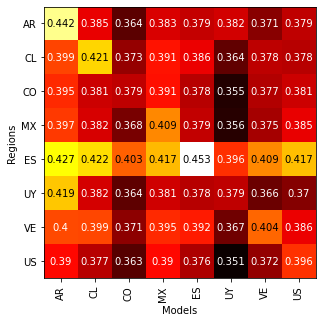
| The accuracy of the models trained on the MLM task for different regions are: |
|
|
|  |
|
|
| # Pre-requisites |
|
|
| You will need TensorFlow 2.4 or newer. |
|
|
| # Quick guide |
|
|
| Install the following version for the transformers library |
| ``` |
| !pip install transformers==4.30.2 |
| ``` |
|
|
|
|
|
|
| Instanciate the tokenizer and the trained model |
| ``` |
| from transformers import AutoTokenizer |
| from transformers import TFAutoModel |
| |
| tok = AutoTokenizer.from_pretrained("guillermoruiz/bilma_mx") |
| model = TFAutoModel.from_pretrained("guillermoruiz/bilma_mx", trust_remote_code=True) |
| ``` |
|
|
| Now,we will need some text and then pass it through the tokenizer: |
| ``` |
| text = ["Vamos a comer [MASK].", |
| "Hace mucho que no voy al [MASK]."] |
| t = tok(text, padding="max_length", return_tensors="tf", max_length=280) |
| ``` |
|
|
| With this, we are ready to use the model |
| ``` |
| p = model(t) |
| ``` |
|
|
| Now, we get the most likely words with: |
| ``` |
| import tensorflow as tf |
| tok.batch_decode(tf.argmax(p["logits"], 2)[:,1:], skip_special_tokens=True) |
| ``` |
|
|
| which produces the output: |
| ``` |
| ['vamos a comer tacos.', 'hace mucho que no voy al gym.'] |
| ``` |
|
|
| If you find this model useful for your research, please cite the following paper: |
| ``` |
| @misc{tellez2022regionalized, |
| title={Regionalized models for Spanish language variations based on Twitter}, |
| author={Eric S. Tellez and Daniela Moctezuma and Sabino Miranda and Mario Graff and Guillermo Ruiz}, |
| year={2022}, |
| eprint={2110.06128}, |
| archivePrefix={arXiv}, |
| primaryClass={cs.CL} |
| } |
| ``` |